#Review: Musafir Cafe- Three Toxic People, One Cafe, and a Lot of Unnecessary Drama
I think I may have an unpopular opinion about Musafir Cafe, because while the internet seems to have divided itself into Team Sudha, Team Preeti and Team Chander, I have a much simpler question: why are we pretending that any of these three people are particularly healthy relationship material?

Because honestly, all three are toxic in their own ways.
And before we get there, let me say this: this is not a new plot. The “great love, separation, new relationship, and then the ex suddenly walks back into the picture” trope has been around forever. Bollywood itself has milked it repeatedly—from Dhadkan to countless films and shows where an old lover magically develops impeccable timing just when everyone else has finally moved on. Musafir Cafe isn’t reinventing the wheel; it has simply parked the wheel in Mussoorie and added a cafe. Even Netflix’s own synopsis openly frames the story around Chander, Sudha, their separation and his eventual life with Preeti.
And that brings me to my biggest problem with the adaptation.
The book actually gives this story closure. Netflix, apparently allergic to closure, decided to interfere.
Having read the novel, I found its conclusion far more satisfying because it allowed the characters to arrive somewhere emotionally. The series instead gives us a giant TO BE CONTINUED and expects us to sit around wondering whom Chander will choose. The cliffhanger has predictably fuelled speculation about Season 2, which has now officially been announced.
But honestly? I don’t care.
Because none of the three characters has managed to make me invested enough to spend another season watching them make questionable decisions.
Sudha: The one person who actually knew what she wanted

This is probably where I will annoy people.
Of the three, Sudha was actually my favourite.
Yes, I know. The internet has been busy calling her a red flag, and Vedika Pinto herself has addressed the debate around the character.
But here’s the thing: Sudha was remarkably clear about her priorities.
She loved Chander. There is no doubt about that. But she was also very clear that she didn’t want marriage or the conventional committed relationship he wanted. She chose her career and her independence when she had to choose between the two things she valued.
You can disagree with her choice. You can dislike her choices. But at least she knew what she wanted.
And when she eventually chooses her life over the relationship, I didn’t see a villain. I saw someone making a difficult choice. Meanwhile, we seem very comfortable judging a woman for wanting a live-in relationship rather than marriage, as though refusing the traditional template automatically makes her selfish. I actually loved her energy. Kudos to Vedika Pinto for playing a character who is messy, frustrating and yet refreshingly unapologetic about what she wants.
Preeti: Sympathy isn’t the same as compatibility

I understand why people sympathise with her. She waits. She supports Chander. She builds a life with him. She becomes his partner in the cafe. And she clearly loves him.
But here’s where I struggled.
Preeti herself admits that her dreams evolved and that she may not even have realised some of them had she not met Chander. At one point, she describes the traveller in her as having paused.
And that’s precisely the problem.
Why are you putting your life on pause for a man who has repeatedly been spectacularly unclear about where he sees you in his future?
That’s not romance. That’s an extremely risky investment with terrible returns. Her intuition is actually pretty sharp. She senses Sudha’s presence and seems to understand that the past isn’t as dead as Chander would like everyone to believe. And yet she chooses to risk everything. I can respect the courage. I just can’t romanticise the sacrifice.
And then there is Chander.
My least favourite.
By a considerable margin.
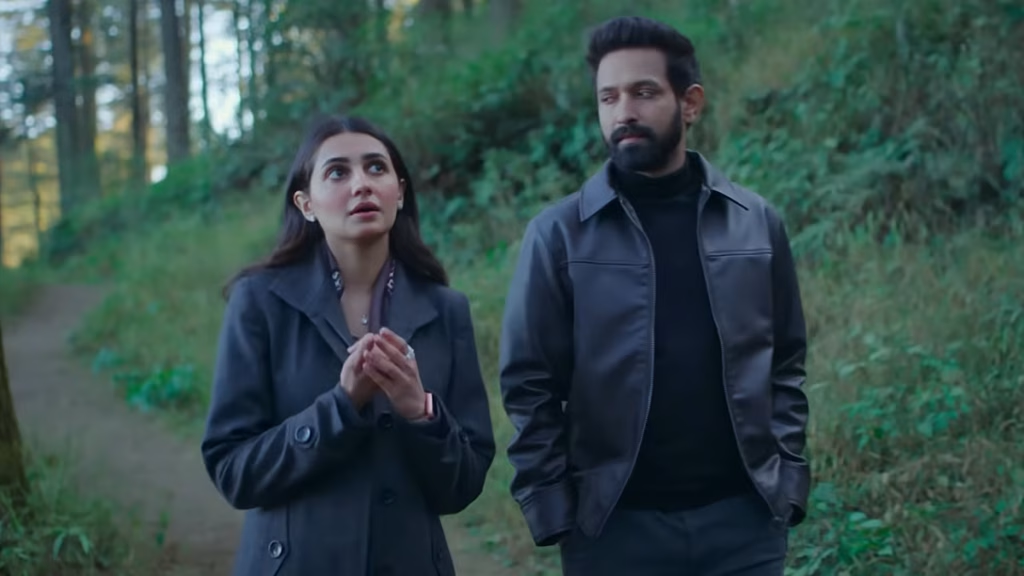
Vikrant Massey is, of course, a terrific actor. There are moments when Chander is genuinely adorable. But somewhere between being the dreamy lover boy and the perpetually confused man making one questionable decision after another, I lost patience with him.
And yes, there is also the age issue. Massey plays a lover boy convincingly enough in certain scenes, but Vedika Pinto and Mahima Makwana look considerably younger beside him, and the age gap sometimes becomes difficult to ignore. Remove that from the equation, though, and the bigger problem remains:
Chander has no spine.
His priorities seem to change depending on which woman happens to be standing in front of him. Sudha makes him realise he wants the mountains. Sudha leaves, and he goes to the mountains. Preeti is there, and suddenly she becomes his partner. Sudha returns, and suddenly the man who supposedly built a life has apparently misplaced all his convictions.
At one point, he is ready to leave everything and go to Mumbai with Sudha. Then he moves to Mussoorie and builds the cafe. He calls Preeti his partner but never quite seems capable of giving her the emotional certainty she deserves.
And then there is the biggest red flag of all:
He names the cafe Musafir Cafe.
Sir. You moved to another city, built a new life and opened a cafe—and then named it after the relationship you supposedly left behind?
That’s not moving on. That’s opening a franchise of your unresolved feelings.
There is an old saying: the first time you make a mistake, it may not be your fault. The second time, it probably is.
Chander seems determined to test that theory.

And then there is Rahil, who honestly deserves far more attention than he gets. While everyone is busy dissecting the Sudha–Preeti–Chander triangle, Rahil is quietly standing there being one of the most genuinely sincere people in the entire story. His affection for Preeti never feels like a transaction. He genuinely admires her, respects her and seems to see her for who she actually is—not as someone’s partner, not as someone waiting around to be chosen, but simply as Preeti. And the irony is that Preeti, who spends so much time waiting for someone who can’t make up his mind about her, completely fails to see the person who is actually looking at her with such uncomplicated adoration. Rahil deserved better. Preeti deserved to notice. And Chander deserved to be left alone with his cafe and his unresolved feelings.
Final verdict
Musafir Cafe isn’t a bad concept. It isn’t even a bad-looking show. The performances are decent, the mountains are beautiful and there are moments of genuine warmth.
But the story is hardly groundbreaking, the characters are frustrating, and the adaptation’s biggest creative decision—to abandon the book’s closure in favour of a cliffhanger—felt completely unnecessary.
It also reminded me of Nobody Wants This. I survived the first season because there was enough charm to keep me going. Season 2 lost me almost immediately because the story seemed determined to go around in circles.
Apparently, I am simply not good with recommendations.
Every time someone tells me, “You HAVE to watch this,” I watch it and subsequently question their judgement.
Musafir Cafe is my latest casualty.
And no, I am not watching Season 2.
Three complicated people, one unnecessarily extended love triangle and a Netflix algorithm that clearly knows how to keep us hostage.
I’ll take my closure elsewhere, thank you.