#Review: Hanuman Ansh- More Than a Story of Devotion
I am a firm believer in God. And if not God, then in the energy that created us and somehow keeps directing us towards the purpose we are meant to fulfil.
So when I first heard about Neeb Karori Baba, I honestly didn’t pay much attention. I had visited the temple, but I had never really felt the urge to read about him or understand his life. The interest simply wasn’t there. And yet, when I visited the place, there was something about it that felt… different. A certain stillness. A certain energy. Almost as though I had been called there. And I probably wouldn’t have gone otherwise.
So when Hanuman Ansh released, I knew I had to watch it.

And perhaps what surprised me most was how unassuming the film is. At a time when spirituality on screen can easily become synonymous with grand sets, dramatic VFX and larger-than-life spectacle, Hanuman Ansh chooses to remain remarkably simple. It feels unrushed, quiet and almost meditative. There is a genuineness to the film that is difficult to manufacture. It doesn’t constantly try to tell you that you are watching something profound. It simply allows the story to unfold.
And a huge part of that comes from the actors. Every actor does complete justice to their part. There is no performance that feels unnecessarily theatrical or as though it is trying to compete with the spirituality of the story. The performances are restrained, believable and deeply rooted in the world of the film. That sincerity is what makes the emotional moments land. You aren’t merely watching characters perform devotion; after a while, you begin to feel it along with them.
The story follows Lakshmi Narayan, a young boy who loses his mother and is told that she has gone to Ram. And instead of processing grief in the way we conventionally understand it, he arrives at an almost childlike but profoundly powerful conclusion: if his mother has gone to Ram, then he must find Ram. His grief becomes a calling.
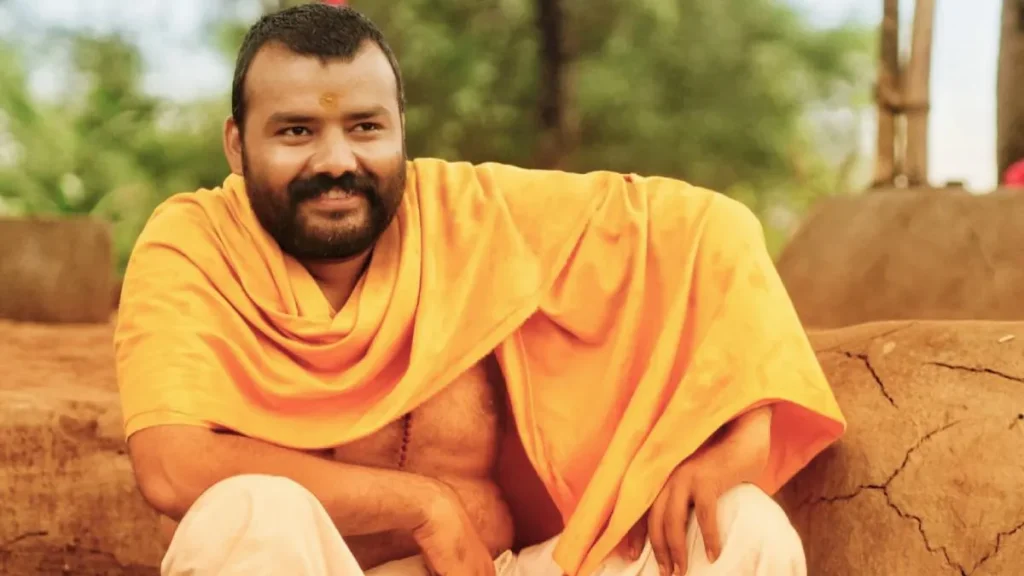
That, for me, is one of the most beautiful ideas in the film. We speak so much about the stages of grief—denial, anger, bargaining, depression, acceptance—as though grief has a prescribed syllabus. Lakshmi doesn’t follow the syllabus. He turns loss into pursuit. He doesn’t ask, “How do I live without her?” He asks, “Where has she gone?” And that single question changes the trajectory of his life.
His search takes him through temples, forests, rivers and villages. He wanders because he refuses to let himself become attached—not even to places that offer him comfort. The destination, in his mind, is always Ram.

And somewhere along that journey, something extraordinary happens. He seems to become increasingly attuned to nature. He hears birds, understands animals, senses what people are feeling. There is almost a telepathic relationship between him and the world around him. It reminded me of everything I have ever read about the idea of nature not being separate from us, but being part of the same living whole.
His spirituality also evolves from seeking God to serving creation. And I think that is where the film becomes much more than a story about a saint. The miracles are interesting, certainly, but they are not really the point. Compassion, service, surrender and faith gradually become the real expressions of devotion.
And then comes Hanuman.
Lakshmi understands that if he wants to reach Ram, he must find the one who is closest to Ram—Hanuman. His devotion therefore becomes centred around Hanuman, and the title Hanuman Ansh begins to make sense. It is about a life shaped by Hanuman’s qualities—devotion, surrender, service and absolute faith.

But what I loved most was the genuine vibe of the entire film. There is something wonderfully organic about the way spirituality is portrayed. Nothing feels forced. Nothing feels like it is trying too hard to create a “spiritual moment.”
Except perhaps one thing—and this was my favourite part.
Throughout the film, the actors begin saying “Sita Ram.” And slowly, almost imperceptibly, the audience starts becoming part of that rhythm. By the end, when the chanting becomes louder, the people sitting in the theatre were chanting “Sita Ram, Sita Ram” along with the film.
And honestly, what a way to end a spiritual journey.
For a few minutes, the distinction between the screen and the audience seemed to disappear. We weren’t just watching Lakshmi’s journey anymore; we were participating in it in our own small way. A theatre full of strangers, suddenly united in the simplest possible chant.
Sita Ram.
That stayed with me more than any grand cinematic moment could have.
Because ultimately, what Hanuman Ansh left me with wasn’t a particular miracle. It was the idea of purpose emerging from pain.
Sometimes we think spirituality means having all the answers. Perhaps it is the opposite. Perhaps it begins with one question that refuses to leave you alone.
For Lakshmi, that question was: Where is Ram?
And in looking for Ram, he found Hanuman. In finding Hanuman, he found service. And somewhere along the way, the boy who had set out to find his mother found something much larger than what he had originally been searching for.
That is what Hanuman Ansh left me with—a strangely peaceful thought: maybe we don’t always choose our calling. Maybe sometimes, our calling chooses us.
And sometimes, perhaps, it even brings us to a place we never intended to go.
Or to a theatre where, by the end, you find yourself quietly saying—
Sita Ram.

You May Also Like

To Everyone Who Thinks Football Is Boring…

Indian Matchmaking: A Cruel Mirror
